
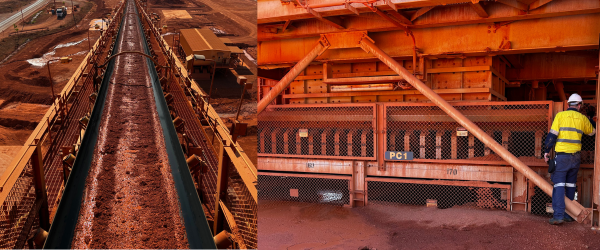
In mining, productivity has traditionally been measured in tonnes per hour. But across Australia’s most advanced operations, a new metric is taking precedence: reliability.
Because in today’s environment, the real cost isn’t just how much you produce. It is how often you stop.
Every unplanned shutdown, every belt failure, every dust-related compliance breach carries compounding consequences. Lost production, increased safety exposure, maintenance fatigue, and rising operational costs all stem from one root issue: instability in conveyor systems, the backbone of modern ore processing.
The Hidden Cost of “Normal” Downtime
For many operations, downtime has become an accepted part of doing business. But the numbers tell a different story.
In one iron ore operation in Western Australia, unplanned downtime at a critical load zone was costing up to $1.5 million per hour in lost production.
In a Northern Territory bauxite site, conveyor belts were being replaced every six months at $600,000 per changeout, driven by premature wear and ineffective skirting systems.
These aren’t isolated issues. They are systemic. And they point to a broader industry challenge: Conveyor performance is often reactive, not engineered.
From Reactive Maintenance to Engineered Reliability
The shift we’re seeing across leading mining operations is clear. There is a move away from reactive maintenance models toward engineered reliability strategies.
This means designing conveyor systems not just to function, but to perform consistently under:
- Extreme loads
- Highly abrasive materials
- Continuous duty cycles
As highlighted in Kinder’s ore processing solutions, wear, spillage, and unplanned downtime directly impact safety, throughput, and operating costs, making conveyor performance a strategic priority rather than just a maintenance concern.
Where Reliability is Won (and Lost): The Transfer Point
If there is one place where reliability is most at risk, it is the transfer point.
Here, impact forces, material turbulence, dust escape, and belt wear converge. These conditions often trigger the failures that lead to shutdowns.
Three key failure modes dominate:
1. Impact and Structural Stress High energy load zones can cause premature failure of rollers, frames, and belts. Without proper impact absorption, vibration and misalignment increase, accelerating wear and reducing efficiency.
2. Dust and Spillage Fugitive dust does not just create housekeeping issues. It introduces safety risks, environmental non-compliance, and equipment degradation. In high tonnage copper operations, inadequate sealing led to widespread fines accumulation, reduced visibility, and increased maintenance exposure.
3. Skirting Wear and Belt DamageConventional rubber skirting struggles under abrasive conditions. This leads to rapid wear, increased belt drag, and frequent maintenance intervention, all of which contribute to unplanned downtime.
Engineering Stability into the System
Solving these challenges requires more than incremental improvements. It demands a system level approach.
At Kinder, this means engineering conveyor solutions that stabilise load zones, control material flow, and extend component life across the entire system.
Key innovations include:
- Advanced impact idler systems that absorb energy, stabilise belts, and extend component life in high-capacity applications
- Engineered dust sealing technologies that capture fugitive dust at the source while reducing belt drag and energy consumption
- High performance polyurethane skirting that delivers longer wear life and consistent sealing in abrasive ore environments
These solutions are not theoretical. They are proven in the field.
Real World Results: Reliability in Action
When reliability is engineered into conveyor systems, the results are transformative.
- A bauxite operation achieved 300 percent belt life extension and eliminated downtime linked to skirting failures, unlocking $2 million in annual savings.
- A copper site significantly reduced airborne dust and maintenance hours by implementing engineered sealing at critical transfer points, improving both safety and system reliability.
- An iron ore operation eliminated unscheduled shutdowns entirely, extending roller life from monthly replacements to over 18 months, while increasing belt life by approximately 30 percent.
These outcomes highlight a critical insight: Reliability is not just about preventing failure. It is about enabling sustained, predictable performance.
Reliability as a Strategic Advantage
As mining operations continue to scale in complexity and throughput, the margin for error is shrinking.
Safety standards are rising. ESG expectations are tightening. Production targets are becoming more demanding.
In this environment, reliability is no longer a maintenance KPI. It is a strategic differentiator.
Operations that prioritise engineered conveyor performance will:
- Reduce total cost of ownership
- Improve safety and compliance outcomes
- Unlock higher, more consistent throughput
- Minimise operational risk across the asset lifecycle
The Future of Conveying
The future of mining is not just about moving more material. It is about moving it smarter, safer, and more reliably.
That starts with rethinking conveyors not as individual components, but as critical systems that underpin operational success.
At Kinder, we partner with mining operations to engineer that reliability into every stage of the conveyor lifecycle, from assessment and design through to optimisation and ongoing support.
Because when conveyors perform, everything else follows.
Is your operation engineered for reliability, or reacting to failure?
Let’s start the conversation.