
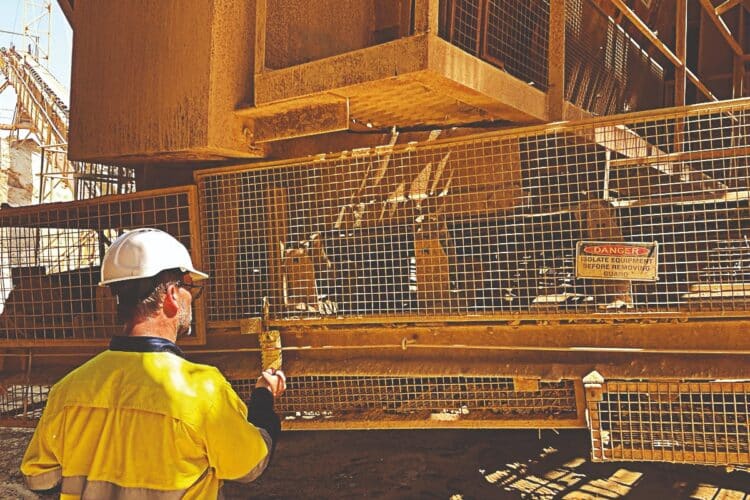
Kinder Australia is “walking the belt” to help spot ways quarries can improve conveyor productivity, safety, and longevity.
A fresh pair of eyes on a quarry site can reveal things that quarry staff may have normalised or overlooked.
This is the basis of Kinder Australia’s conveyor health checks.
“When someone sees the site for the first time, they can spot the areas of improvement or potential hazards,” Kinder Australia field application specialist Jason Whitwell told Quarry.
Tailored to each quarry’s specific requirements, each health check aims to improve performance and minimise risks through a comprehensive site visit.
Starting with a pre-consultation, Kinder Australia’s field application specialists work closely with quarries to discuss their specific problems, needs and expectations.
Whitwell said Kinder Australia’s team will then “walk the belt”, inspecting its operation and noting down problems for later attention.
“We go along the length of the conveyor, taking photos and measurements, looking for any potential problem areas,” he said.
“We cover the conveyor from top to bottom, using an iPad to document everything we come across. This means looking at the standard components, making sure there’s no structural damage, spillage, or anything that is not up to standard.
“Sometimes, the issues we find are sitewide, while others could be tracking issues on an individual conveyor.”
The photographs, videos, and other information are then collated into a report that helps form the basis for future reporting. It provides a summary of what issues the site is facing, highlights where the site is performing well, and provides a conveyor-by-conveyor breakdown.
Whitwell said one of the most common issues that Kinder’s specialists find in quarries is poor belt condition.
“Quarries are looking for increased volumes and conveyor capacities around the country, which requires equipment to be in peak condition,” he said.
“Conveyor health checks identify immediate and future wear, plus, we provide a detailed performance analysis.”
Often, poor belt condition is the result of mistracking. Kinder Australia’s team checks to make sure each belt has the right type of tracking system to suit the conveyor belt’s speed, direction, trough angle, and material loading. Specialists also look for any alignment problems and can provide solutions to promote the correct conveyor alignment. Kinder’s range of idler frames can support this effort.
The K-Retractable Idler/Impact Frames range are suitable for all bulk material handling applications, while the K-HD Retractable Impact Frames are applicable for the toughest quarrying and mining applications.
They allow conveyor rollers to be changed out under transfer loading chutes without requiring the frames to be removed.
Kinder’s check-up reports help site managers plan their maintenance processes and can assist with budgeting.
Whitwell said it helps quarry management understand what problems need a simple solution and what ones require a more comprehensive approach.
“For example, some customers think that fixing belt tracking could be hard or an expensive thing to fix, when it is probably a lot more affordable than they would think,” he said.
“The report breaks down what is the highest priority, so site management can gradually roll out improvements over the coming months to keep expenses low.
“We also educate sites on the importance of including belt cleaners and the importance of removing carryback. One major benefit is that carryback on pulleys and return rollers can affect their performance, which leads to a flow on effect. By installing a belt cleaner, the conveyor becomes safer, more reliable, and more productive.”
Carryback can also lead to belt and structural damage as fugitive material can build up to bury idlers, conveyor components, or structural supports, furthermore, requiring clean-up labour or even the replacement of parts. Primary belt cleaners, like Kinder’s Micro Eraser Primary Belt Cleaner can play a vital role in reducing carryback and keeping conveyor belts running smoothly and efficiently.
Many of the sites that Kinder Australia’s field application specialists visit are located in Australia’s remote or regional areas.
For these sites, minimising downtime and maintenance is even more important than usual, as it can take longer to get things up and running again if something goes wrong.
Whitwell said these clients often appreciate Kinder Australia putting in the effort to see the site in person.
“Clients are usually grateful for the report,” he said. “The proactive ones get started on finding ways to improve their plant.
“Anyone can reach out to us to organise a conveyor health check. Our team of field application specialists are ready and eager to help.”
This was originally published in Quarry Magazine.